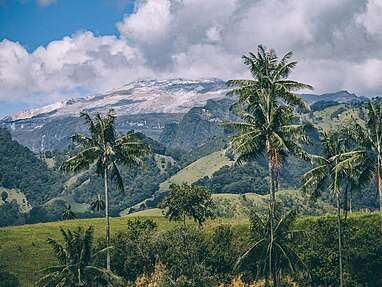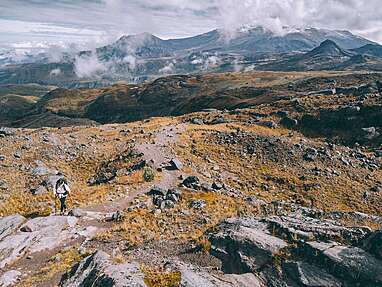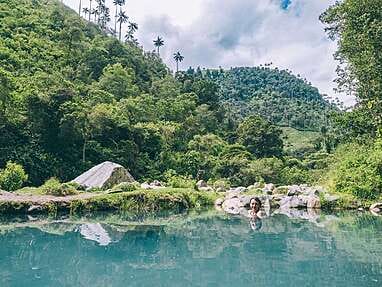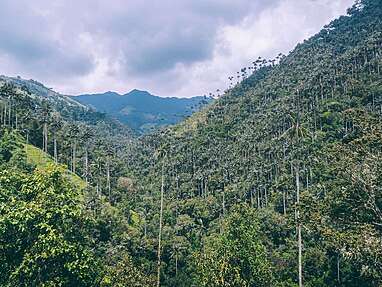


Let’s face it, the Cocora Valley has become one of Colombia’s most visited nature destinations. Who hasn’t seen those images of immense, majestic palm trees enthroned in the middle of a verdant mountain valley? Well, the answer is: nobody.
Over the last ten years, tourism has developed at breakneck speed, for better but mostly for worse. The Cocora Valley has gone from being a natural site where people come to hike to an (almost) amusement park where people come to take photos.
Far be it from us to advise you against visiting the Cocora Valley, but it’s important for us to talk about reality and the alternatives that allow you to admire sublime landscapes covered with wax palms far more impressive than Cocora.
In any case, here you’ll find all the information you need about the Cocora Valley Day Trek, a relatively easy hike and the highlight of any stay in Salento.
Contents
Related posts

General information Los Nevados Natural Park
- Protected Area: Los Nevados National Nature Park
- Ecosystem: Cloud forest
- When to go: all year round
- Temperatures: 15° C average
- Climate: Cool and humid
- Minimum altitude : 1800 m avg.
- Max. altitude : 2400 m avg.
- Region: Andes
- County: Quindio
- Distances: 10km from Salento, 30km from Filandia

The Travel insurance we recommend in Colombia
We live in Colombia, and we can confirm that private healthcare is very expensive here. Private clinics in Colombia generally only admit patients who have insurance.
Coverage up to 2.5 M€ · 24/7 assistance in english · Hospitalization · Medical evacuation · Luggages
Excellent · 4,6/5 · Trustpilot · 1 599 review
Welcome to the Cocora Valley
AND ITS IMMENSE WAX PALMS

The Cocora Valley lies just a few kilometers from the typical, colorful village of Salento, within the Los Nevados National Natural Park in the department of Quindio. The region is renowned for its coffee and its typical zona cafetera landscapes, combining mountains, plantations and quiet villages.
The Cocora valley is home to a natural curiosity, a unique species of palm tree: the wax palm!
This incredible palm can grow up to 60 m tall, making it the tallest palm in the world. It is so named because wax can be extracted from its bark to make candles, for example. The wax palm is endemic to the Colombian Andes, and its splendor has made it one of Colombia’s official symbols.
Threatened with extinction, it has been classified as a protected species by the Colombian government for some years now.
All this to say that you are in the presence of a true treasure of nature, something you’ll only see once in your life.
We don’t know about you, but for our part we’re quite sensitive to the symbolism of things, and this kind of information adds an emotional, even mystical character to my travel discoveries. When we’re there, on the spot, we can measure our good fortune, take in the magnitude of what surrounds us, and put ourselves, little humans, back in the place of simple observers, respectful and grateful.
Unfortunately, with the development of tourism in Salento, local landowners decided to create attractions dedicated to tourism right in the middle of the famous “Bosque de Palma”, destroying the natural panorama that only a few years ago was the charm of the Cocora Valley.
A parking lot, huts where you can eat, buy a few trinkets, spots to take a photo for Instagram… Sunday hikers, mountain bikers in full shampoo and beard outfits, families in moccasins who’ve come just to get to the Bosque de Palma, classic stuff.
Many tourists (mainly Colombians) come here just to see the palm trees, take a selfie and then leave.
But we’re sure you’ll want to take your time, like us, and do a real hike in the Cocora Valley. A 12km loop that will still allow you to enjoy the mountains and landscapes, but won’t spare you the shock (final or initial) of the disaster that tourism has caused.
Highly recommended local agency
Contact Cristina to visit Cocora Valley
Hiking in the Cocora Valley
A BEAUTIFUL Hike

Let’s move on to what really interests us: the hike itself. As you’ll have gathered, we strongly recommend that you don’t just go and see the bosque de las palmas (accessible directly from the park entrance), but take the whole day to do the loop, starting at the valley floor, climbing up to the hummingbird house (optional) and then coming back along the mountainside path that will take you straight to the Graaaaaal: the famous bosque de palmas.
The loop is about 12 km long, which is quite a hike, but if you take your time, it’s really not that difficult. There is one main difficulty: the ascent to the finca La Montaña, which is quite intense, but relatively short (if you do the loop the other way round, it becomes a descent).
What’s interesting about this short hike of just a few hours is that it takes us through different landscapes and moods. We start out in an alpine, pastoral spirit, with a few wax palms on the heights. When it rains, the path can be muddy, but the whole start is gently sloping and very easy. Then we enter the cloud forest, that very special biotope of mountain rainforests. The vegetation is luxuriant, and we cross monkey bridges over the river – it’s like Indiana Jones!
The path gradually begins to rise, and at a crossroads you’ll have to decide whether to continue a little further to the hummingbird house, or turn off towards the La Montaña finca. If you have time, you can make the round trip to Acaime, the hummingbird house. It’s expensive for what it is, but if you want to be sure of seeing hummingbirds, don’t hesitate to go up.
Colombia has one of the greatest diversity of hummingbirds in the world, with over 120 different species.


Back at the fork in the road to La Montaña finca, you’re about to embark on the most difficult part of the climb – an intense but relatively short climb. Take your time, take it easy and it will go by itself. Look up, the trees are changing, the vegetation is changing, and when a clearing opens up you’ll see the finca La Montaña, where you can have a drink and a breather if you need to.
At this point, you’re done for! The rest of the hike is all downhill to your final destination, el bosque de las palmas, with its “Cocora” in giant letters, its Willys Jeeps set against the landscape, its arches and wings and… In short.
On the way back, below you, the valley you’ve just come from stretches out, and you’re finally at the height of the wax palms, see how they punctuate the landscape in a beautiful photogenic display. Along the way, numerous “Miradors” have been created to take in the view.
Then comes the bosque de palmas. On Samuel’s first visit to Cocora in 2013, he wrote: “The green of the meadow invites the epicurean to roll in the grass of joy, the majesty of the wax palms, like little old men with gentle eyes, make us want to kiss them and let them tell us their secrets. Wisdom reigns here, we sit, we sit and we contemplate. Shhhhhhhhhh.”
Today, barriers, signposted routes and attractions of all kinds no longer invite contemplation, but rather… escape.


Good to know
The wax palm, an endangered species
Be aware that this landscape has been sculpted by man for livestock, and that it is this deforestation to make way for pastureland that has led to the loss of over 70% of the Cocora Valley’s palm trees since 1985… enough to keep you thinking!
Today, the Cocora Valley is home to just 2.000 wax palms, almost all of which have reached an advanced age and are therefore dying on the ground.
To reproduce, the wax palm needs the shade of a forest where the plant can develop slowly, over several decades, before breaking through the sky and reaching 60m in height and 150 or 200 years of age…
However, in an open meadow like those in the Cocora Valley, the seeds of the wax palm will fall to the ground without being able to germinate or develop, as they will either be eaten or trampled by cows, or if they are lucky enough to escape, the young plants will be burnt by the sun.
Replanting programs have been underway for a number of years now, but the specificity and slow growth of the wax palm make this difficult. It’s a safe bet that in a few decades’ time, the Cocora Valley will be nothing more than a prairie landscape without wax palms.
Highly recommended local agency
Contact Cristina to visit Cocora Valley
The lesser-known alternative to Cocora
Largest concentration of wax palms
It’s no secret that the Cocora Valley is not the only place in Colombia where you can see wax palms! In fact, today it’s probably one of the least interesting places in Colombia to see them…
Here are some of the alternative sites to the Cocora Valley where the wax palm can be seen in Colombia:
- Murillo, Tolima
- Pijao, Quindio
- San Felix, Caldas
- Toche, Tolima
- Anaime, Tolima
- Roncesvalles, Tolima
- Tenerife, Valle del Cauca
- El Palmar, Boyaca,
- Serranía de Perijá, Cesar,
- Sierra Nevada de Santa Marta, Magdalena
- Etc.
The Carbonera Valley (Toche)
And the Carbonera Valley is one of the best-known of these lesser-known places.
La Carbonera is reputed to have the largest concentration of wax palms in the world! The Carbonera Valley is home to 80% of all the wax palms found between Peru and Venezuela… so you could say 80% of all the world’s wax palms, since this species is virtually endemic to the region. It’s amazing.


However, as in the Cocora Valley, the wax palm is also endangered here. Programs are underway to protect the Carbonera, and it is hoped that tourism will not accelerate the problem.
Samaria Valley (San Felix)
On the Salamina side of the Caldas, between Medellin and Manizales, lies the small village of San Felix. A traditional hamlet where life revolves around the milk factory. And just a few minutes from the main square, you’ll find the Samaria Valley. A small valley where wax palms, a different species to those seen in Cocora or La Carbonera, proudly display their beauty..


Murillo
Murillo is a destination that for us represents a spectacular alternative to Salento and the Cocora Valley. Located 2 hours from Manizales on Colombia’s most beautiful road, the village perched at 3000m offers an incredible diversity of possibilities. Not least of which is the opportunity to observe spectacular landscapes where wax palms play the leading role.


In the meantime, if you want to get off the beaten track, we suggest you consider these alternative options to the Cocora Valley.
Local guide for a trek in Cocora Valley
Recommended local agency
There are several guide agencies in Salento, but we really advise you to use the services of our local partner, who, in our opinion, is probably the best guide agency in Salento.
Responsible tourism
Our partner is the first trekking operator in Colombia to have been awarded the Tourcert certificate and is working to develop a responsible tourism policy:
- Joint work with National Park authorities
- Guides certified in high mountain first aid
- Employment of local people with fair wages
- Contributing to the local economy with the aim of improving working conditions
- Commitment to local communities (school tool collection programs)
- Application of “Leave no trace” principles
Where to stay in Salento
Salento

Hotel
Salento Plaza Hotel
A superb hotel in Salento, in a beautiful colonial house very close to the main plaza.We would have loved to have stayed there, to tell you the truth! The decor is superb, and there’s a small interior garden that invites you to relax. The rooms are spacious and the bedding looks comfortable.Highly rated
Salento

Hotel
Hotel Vista hermosa
A nice hotel, and above all, very attractively priced for a city like Salento! This is where we stayed on our last trip in February 2022Basic but comfortable rooms, perfect cleanliness, good service.
Salento

Hostal
El Viajero Hostel Salento
A chain of hostals found in Cartagena, Cali and San Andres. Newly installed in Salento, El viajero offers a wide variety of rooms to suit all budgets, and can accommodate up to 90 people. Having said that, we have to admit that the location they have chosen has everything to seduce!
Salento

Hostal
Segrobe City Hostel
Somewhere between a hotel and a hostal, here’s a place where the decor is particularly meticulous! We love the ambiance of this superb colonial house. The location is central, just a few steps from Salento’s main square. But beware: almost all rooms face the street.
Salento

Finca
La Cabaña Eco Hotel
A hotel in a sublime traditional Colombian finca. A real value for money, located just outside the village, in the countryside. They offer a wide range of activities, including horseback riding and birdwatching.
Salento

Hostal
Yambolombia Hostal
This is the hostal where we stayed on our first visit to Salento. It’s a house on the outskirts of the village, about 20mn from the village on foot, 5mn by Jeep. Gabriel is an endearing character and the atmosphere is cool. Everything is meticulously maintained.
How to get to the Cocora Valley
First of all, you’ll need to travel to the Pereira and Armenia region and stay in a Quindio village. The nearest is Salento, of course, but other options such as Filandia are just as interesting.
From Salento
The famous Willis Jeeps will take you to the Cocora Valley. Make your way to the village’s central square, where you’ll see the colorful machines waiting to take off. Ask a driver, and he’ll tell you when the next departure is.
- Leave as early as possible to avoid the crowds!
- Fare: $8.000 COP per person (one-way)
- Timetable: Every 30 minutes from 5.30 a.m. / The last Willy Jeep leaves Cocora at 6.30 p.m
- Journey time: approx. 30 minutes,
- Distance from Salento: 12 km
From Cocora to Salento
The last Jeep Willis leaves at 6.30pm! Take your precautions, but in any case, night falls at 6pm in Colombia, so we advise you not to be on the road at that time… But if you’ve listened to us and left early,
Equipment for the trek?
Even if it’s only for a day, you still need to be prepared for a trek in the Cocora Valley. First of all, you’re going for a day’s walk, and secondly, you’re going into the mountains, starting at 2400 m and climbing to 2900 m altitude. The weather can be very changeable, and if it rains the path can be very muddy!
Camping is forbidden in the Cocora Valley. However, there are places around the site where you can pitch a tent for a small fee.
- Good footwear (hiking boots, if possible, and waterproof) or boots (hire on site)
- Waterproof jacket / Windbreaker
- Wool sweater or fleece for cold weather
- Sun cream or hat for the sun
- Snacks for picnicking along the way
- Plenty of water!
Price and practical information
You can make the loop begining from the bottom of the valley or begining from the mountainside path. Whichever way you choose, you’ll have to pay all the entry and exit fees.
The « La Truchera » entrance
This is the one we advise you to start with.
Entrance/Exit fee: $6.000 COP
You start off in the bottom of the valley and go all the way into the forest. You then have the choice of pushing on to Acaime, the hummingbird house and returning to the crossroads that leads you up to the Finca la montaña, or climbing straight up to the Finca to find the mountainside path leading back down to the Bosque de Palmas.
The “Bosque de palma” entrance
This is the one that leads you directly to the most famous point of view of the valley. Unfortunately, the Cocora valley’s success as a tourist destination has made this specific place a terrible disappointment (from our point of view).
Entrance/Exit fee: $20.000 COP
From there your can follow the mountainside path to Finca La montaña and then go down to the crossroads, where you can choose to make the return trip to Acaime or take the return route along the bottom of valley to La Truchera.
Loop distance
Full loop : 15 km
Difference in altitude: 540 m (2400 m – 2940 m)
Where to eat and drink
Once you reach the jeep drop-off point, there’s a lot of options to have a dring and eat. We don’t have recommendations. Once inside the Cocora Valley, there are only three places to eat and drink: Acaime, Finca la montaña and Bosque de Palma
Acaime: the hummingbird house is located at the end of the valley, a little after the turn-off for the ascent to Finca la montaña. Entrance fee: $20.000 COP including “agua panela”.
Finca la montaña: this finca is located at the top of the short, but intense climb back down through the valley foothills, offering spectacular views over the Cocora valley to the Bosque de Palmas.
Bosque de Palmas: This is the best-known site in the Cocora valley, with its meadows dotted with wax palms. For those lazy enough to avoid the trek, you can go directly to Bosque de Palmas from the park entrance, following the signs. Nowadays there a lot of private owners that are taking advantage of the flow of tourists to offer entertainment and selfies opportunities.