


You’ve booked your rental car and you’re ready to hit the road to explore Colombia! Before you get started, we recommend reading these few tips about driving in Colombie from our personal experience on Colombian roads.
In this article you’ll find information on what makes Colombia specific when it comes to driving so you can be as prepared as possible to hit the road in Colombia: traffic laws, the condition of the road network, dangers, driving habits, toll and gas prices, etc. etc. All kinds of things that might surprise you!

The Travel insurance we recommend in Colombia
We live in Colombia, and we can confirm that private healthcare is very expensive here. Private clinics in Colombia generally only admit patients who have insurance.
Coverage up to 2.5 M€ · 24/7 assistance in english · Hospitalization · Medical evacuation · Luggages
Excellent · 4,6/5 · Trustpilot · 1 599 review
Driving license and required documents to drive in Colombia
Driving in Colombia

For this kind of subject, we make a habit of checking our sources on government sites and combining them with our own experience or that of our family and friends in the country.
Which license to drive in Colombia
The Colombian government certifies that tourists can drive with their national license (Código Nacional de Tránsito, Art. 25 de la Ley 769 de 2002 – Licencias Extranjeras)
“Driving licenses issued in another country, in force and used by tourists or persons in transit on national territory, are valid and admitted to drive in Colombia during the authorized stay of their holder, in accordance with international provisions on the subject.”
In all cases, this authorization is reserved for tourists passing through the country. If you are a resident or have a work or other visa, you will need a Colombian driver’s license.
So, international driving license is not necessary?
If you really want to, you can always apply for an international driving permit online, it’s simple and free, but it takes a very long time to receive, so we recommend doing it well in advance!
Our past experience showed us during all the police checks we had to go through that the national driver’s license worked. Today we both have a Colombian driver’s license so it no longer concerns us.
Traffic regulations in Colombia
Driving in Colombia

We’re not going to give you a lecture on the traffic code in Colombia, it’s up to you to be (very) careful when you get behind the wheel. But here is some information that may be useful to you.
Distances
In Colombia, for reasons of geography, condition of the road network and condition of traffic, you don’t count in kilometers but in hours of travel. And this is even more true in mountain regions! So don’t think like your are in the US or other countries and adapt your mindset.
Signage
- Directions: they are not very frequent on road networks outside urban areas, it is sometimes difficult to find your way, hence the importance of using a GPS like Waze.
- Speed: they are quite frequent and well indicated.
- Parking: “No parking” signs indicate a prohibition before and after the sign. We advise you in any case to park in closed parking lots (Parqueadero Publico).
Speed
Since we bought a car here in Colombia, our average speed calculated on the dashboard shows 32 km/h.
This is information to be taken literally. If you rent a car, count on an average of 30 to 40 km/h for your trips.
Regarding speed limits, it’s a real puzzle. Speed limits on Colombian roads change constantly. You go from a section at 80 km/h to a stretch at 40 km/h, then go up to 60 km/h and go back for 100 m at 40 km/h, etc.
The reason? As no road in Colombia has “closed” infrastructures, there are always, even on what could be considered “highways”, potential pedestrian crossings, school zones, or other dangers that impose speed limits.
- Speed on roads: limited to 60 km/h or 80 km/h (even on dual carriageways) depending on the roads — Some portions may be allowed at 100 km/h or more.
- Speed in urban areas: limited to 60 km/h but most often to 30 km/h due to school zones or historic centers…
In reality, compliance with speed limits by users is totally random: some drive like crazy (often big tinted-window SUVs), others drive like snails below the limits (often old cars in bad condition)…
Speed cameras
Be careful, there are cameras everywhere, in the city and outside. We strongly recommend respecting the speed limits and using the Waze app to avoid surprises.
Speed bumps
Watch out for speed bumps!! In Colombia they call them “policia acostado”. They are particularly high and must be taken very slowly! They are most of the time announced about 100 m before, keep your eyes open… but a frequent problem: they are sometimes not signaled… and given their size, it feels strange when you hit them too fast.
This is one of the most important signs to know because there are many of them, everywhere and in totally incongruous places, often justified by a potential intersection, a path arriving on the road, or the entrance to a property.
Pico y Placa
“Pico y Placa” is a model of alternating circulation in the city. It is a traffic regulation system based on the license plate number that is found in most large cities in the country.
So be sure to get information beforehand or risk a heavy fine if you drive when your license plate number forbids it. To do this, type on the internet “Pico y Placa” + the name of the city you’re going to, and you’ll get the days corresponding to the plate numbers that can drive.
In reality
You will see that driving in Colombia is quite “free”, Colombians respect the traffic code very little, they drive as if they were alone in the world, which leads to increased vigilance. We talk about this below in the part “driving in Colombia”.
Best tips
Rent a car in Colombia
To rent a car, we advise you to use the Rental Cars comparator, which gives you a complete overview of the different rental companies in Colombia.
Driving in Colombia
Driving in Colombia

Driving in Colombia, as in any country or almost, is a story of local folklore often representative of the country. Here you will surely find the tips that will be most useful for your car rental.
Waze is your friend
The best advice we can give you is to use the Waze app on your phone to drive in Colombia. The GPS will guide you, give you speed limits, possible speed cameras, etc. Moreover, the announced travel times are relatively accurate (within 30 minutes).
To use Waze, you will of course need to have previously purchased a local SIM card for your smartphone with enough internet “Datos”.
Colombians on the road
You have to assume that anything is possible.
Colombians often drive as if they were alone in the world, and you must therefore be ready to see any vehicle appear on your right or your left, at any speed…
When we say any vehicle, it’s really any vehicle: car, bicycle, motorcycle, truck, tractor, horse cart, handcart, tuk-tuk, etc., etc.
You will realize that there is a real life on the road, with many street vendors who can operate in the middle of nowhere. Sudden stops are therefore frequent on the roadside or even in the right lane.
In general, the right lane is often the place of sudden stops, which is why you will see many vehicles, even very slow ones, driving in the left lane.
In the city, it’s a mess and depending on the regions it’s often the motorcycles that must be particularly watched because they slip through everywhere. Be careful!
The driving to adopt
The best advice we can give you is to breathe, stay calm, follow the flow and try to blend into the traffic. Stay calm and don’t try to imitate the bad habits of Colombians or provoke them.
But at times you will have to elbow your way if you want to merge into traffic, don’t hesitate, everyone does the same, a small hand gesture and there you go! Because in Colombia, no one will let you pass willingly, civic-mindedness is very limited.
As mentioned above, on a dual carriageway it happens that cars stop in the right lane, sometimes buses to pick up passengers, in short, you will see that when there is a dual carriageway most Colombians drive in the left lane. Follow the flow, forget European or US rules and if necessary let yourself be overtaken on the right.
Driving at night
We really advise against driving at night.
Having tried it several times, from our point of view it is too dangerous and tiring. Most Colombians use modified white and very powerful headlights, it feels like they drive with high beams all the time. It blinds, tires, and makes you nervous… it’s super dangerous. There are almost no lighting installations on the roads, so that makes driving even more complicated. And when it rains, then it’s completely unbearable.
We never drive at night anymore. We always plan our driving times to arrive before nightfall (around 6 p.m.).
Best tips
Rent a car in Colombia
To rent a car, we advise you to use the Rental Cars comparator, which gives you a complete overview of the different rental companies in Colombia.
Roads in Colombia
The road network

Roads in Colombia, let’s admit it, are generally in poor condition.
You will sometimes have the nice surprise of driving on something perfectly smooth and you will enjoy it a lot! But honestly you will be more likely to have to avoid potholes, stay alert.
There are no “closed” highways like the ones found in Europe. There are sometimes dual carriageways, but they can quickly turn into a single lane when approaching a city. And in any case, even on dual carriageways there can be pedestrian crossings, school zones, paths arriving on the road, etc.
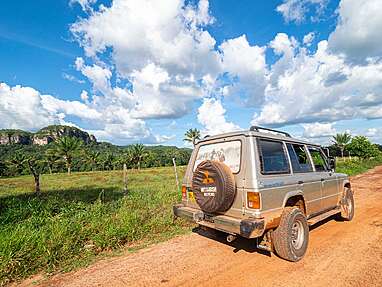
On the secondary network, most roads turn into simple dirt or gravel tracks.
This doesn’t mean they can’t be used by your car. You just have to adapt your driving and go slowly. Of course a car with a slightly high chassis will be more practical (Sandero or Logan models work very well for that).
Which car to choose
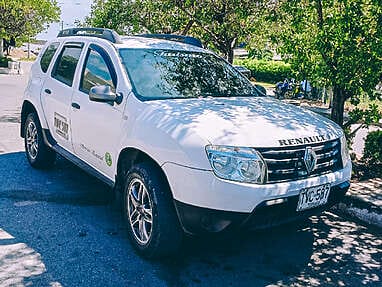
We have traveled thousands of kilometers in Colombia, including on unpaved roads, only with Renault Logans or Sanderos which are the most commons cars in the country. In both cases they are vehicles with a relatively high chassis and that can go almost anywhere.
Period.
There is absolutely no need to rent an SUV or a 4×4 to drive in Colombia in 99% of cases. The roads that require a 4×4 are probably roads where we wouldn’t advise you to go alone and where we would rather recommend being accompanied by a local agency.
Roads in the Caribbean
The Caribbean region is mainly flat land, presenting no particular topographical problems for driving, apart from the Sierra Nevada de Santa Marta mountain range, where roads are virtually non-existent, except on the Minca side.
It’s rather the poor quality of the road network that’s debatable, since many of the secondary roads in the Caribbean region are not asphalted, but are only dirt tracks, making driving difficult at times (especially in the rainy season).
Roads in the Andean region
Mountains mean? Curves! In the Andean region, the roads really do twist and turn, making journeys extremely long and tiring. It’s not uncommon to find yourself behind large trucks travelling at 20 km/h.
Generally speaking, in Colombia you don’t count in kilometers, but in hours, and this is even truer in mountainous regions!
Occasionally, some roads are under construction due to frequent damage caused by bad weather.
Roads in the Pacific region
This is one of the least accessible regions of Colombia. Only 3 towns have road access (Buenaventura, Quibdo, Tumaco). For the rest of the region, especially the villages on the ocean shore, there are no roads: the only possible access is by sea or air.
To the north, the immense and totally inaccessible Darien forest acts as a bottleneck, to the extent that it is the only place on the continent where the famous Pan-American Highway is literally cut off.
Roads in the Llanos region
The entire northern and central part of the los Llanos region is fairly accessible , with roads from Villavicencio to Arauca, Puerto Ayacucho and San Jose del Guaviare.
But throughout the south-east, the forest takes over and there are no roads. This more remote part is often only accessible by plane or by boat along the Rio Guaviare.
Roads in the Amazon region
It goes without saying that this is a difficult region to access.
However, Mocoa in the Putumayo, Florencia in the Caqueta and San Jose in the Guaviare are quite accessible by road, but these are the only roads in the entire region.
For the rest, you’ll have to travel by air, especially to Leticia.
Best tips
Rent a car in Colombia
To rent a car, we advise you to use the Rental Cars comparator, which gives you a complete overview of the different rental companies in Colombia.
Safety and police controls
Driving in Colombia

Documents to carry at all times
It’s obvious, but let’s go over the documents you need to have with you in case of a police check:
- Rental contract (provided by the rental agency)
- SOAT, the car insurance (provided by the rental agency)
- Révision Tecnico Mecanica, the car’s technical inspection (provided by the rental agency)
- Valid passport (over 6 months old) with entry stamp
- Valid national driving license
- Tinted window paper (if your car has tinted windows)
- Optional : Valid international driver ‘s license
Speed cameras
There are many fixed and mobile speed cameras on the country’s roads, as well as at traffic lights in town. So be careful not to get caught out! Just take it easy and you’ll be fine.
Parking lots
To ensure the safety of your vehicle and avoid the frequent thefts, we advise you to always use the paid parking services available throughout Colombia.
For example, for one night, we paid $12.000 COP in Giron.
Tolls
There are a lot of tolls on the main roads, so don’t forget to factor them into your budget. This is also one of the reasons why Colombians travel a lot by bus, or motorcycle for that matter.
On average, a toll costs around $10.000 COP.
Tolls are a good time to ask questions at the cashier’s, to ask for information about the road, its condition, good places to stop for lunch, etc. Don’t hesitate!
Accidents
In the event of an accident, never leave the scene and never move the car before the police arrive, otherwise you’ll be in big trouble. Take pictures and videos as much as you can.
Police
Police and Military checkpoints are a frequent occurrence in Colombia, so stop if you’re flagged down!
Don’t panic: the police will ask you for everyone’s papers and passports, they’ll ask you to get out of the vehicle, they may open the trunk, maybe search the luggage… don’t panic, it’s routine and everything will be fine.
Renting a car in Colombia
Driving in Colombia

All right! You’ve got all the information you need to adapt to driving in Colombia and avoid any unpleasant surprises. Now you’re ready to take the plunge and it’s time to rent a car!
To find out more, read our full post on car rental in Colombia.
Best tips
Rent a car in Colombia
To rent a car, we advise you to use the Rental Cars comparator, which gives you a complete overview of the different rental companies in Colombia.
I live here and since they are trying to go all digital and using cameras for fines, you see open highways with a sign with 80kph and three meters behind it is one for 30kph. Then there is a sign 100m later warning of an electronic speed camera and everyone in the vehicle was wondering what was the real speed. It turned out that the camera was set at 50kph. Take a bus or taxi.
That’s partially right, partially wrong, using Waze permits to avoid problems; we are driving a lot in Colombia and we never got fined. 😉
Congratulations!! Very helpful site. Keep it up.
I plan a journey at Colombia but I feel a little bit wary.
Maybe i will ask you some informations about safety of the country etc.
Congratulations again!!
Hello… Thanks for your good advice, great site 😉 Can you inform me about buying a motorcycle in Colombia or maybe refer me to someone or another site if needed?
Hello Sylvie, we have no idea about this, but you can look on the Colombian “bon coin” websites, you have Mercado Libre or olx.com
I’d like to add two new items to the list of papers you need to carry with you: the SOAT, which is the compulsory insurance, and the Révision Tecnico Mecanica. The rental company must provide them, and these are generally the two documents that the police systematically check. They must, of course, be up to date. If you can’t produce them, the car is immediately immobilized.
Hi, thank you Adrien for this information! It’s true that we didn’t check and when we were stopped by the cops they hadn’t checked the car’s papers, they’d just asked for everyone’s license and passport and searched the trunk. But never mind, it’s better to check with the agency and have them on hand just in case!
In theory, yes, they do. But you still have to be careful. The disadvantage of the SOAT in particular is that it’s only valid for one year, and a careless rental company can give you a car whose SOAT will expire during the rental period, for example. Checks have been tightened up enormously in 2019, and they are more and more attentive to paperwork in order.
Yes, thank you for your testimonial! 🙂